
Hello Reader! It has been a year since I have updated this site. You would think a year hiatus should be more than enough time for an aimless blogger to recharge the batteries, and that would be right, except that the aimless blogger quite comfortably fell out of the practice of blogging, passing the days and weeks in other pursuits instead: traveling or doing things of interest without a thought of sharing it online. Other times he would try to improve his lot. Still other times he would whittle away the hours in idle thought and could have gone on whittling till doomsday had not the gumption to blog returned when it did. When that happened, it had been long enough that he needed a reason to return to to the site. What better reason to return than to report on a fairly recent trip to the distant island of Singapura? My visit there, in as much as it warranted any recognition at all from an audience, [it didn’t] was an inconsequential interlude on a “grand Program of Providence” and judging by today’s broadsheets may have appeared on the bill in the following way:
“Greek riots rattle Europe”
“Oil Leak Threatens Louisiana coast”
“Trip to Singapore by one Jeffrey”
"Flood of Ages drowns Nashville”
“BLOODY BATTLE IN AFGHANISTAN”
The occasion for the trip was a fortunate dovetailing between a marketing conference that Lady T____ planned to attend and Golden Week, a concentration of Japanese holidays at the end of April and beginning of May. She had been to Singapore once before on business and stayed at the Mandarin Hotel, which she described as the nicest hotel she had ever seen. Unfortunately, she didn’t get much of a chance to explore the city. Ever mindful of her complexion, Lady T____ had reservations about spending additional vacation time in Singapore for fear it would be too bright, too hot and too humid for her skin, let alone for a pleasant time. Yet, she recalled that it was a nice looking city and there was a curiosity there. She wanted to go back for the food, the shopping and the fish reflexology. I had long harbored a quiet notion that should the opportunity present itself I would visit this exotic place and see how the sober reality compared to romantic images I had built up over the years from Far East adventure stories, faded photos in dusty volumes, and some Kodachrome
slides taken by my parents during their trip to Singapore in the 1970s.

Singapura! Tamasek! City of the Merlion! The Lion City. A place with snake charmers and rickshaws - Chinese junks and Malaysian skiffs - imposing doormen with heads dressed in turbans, standing cross-armed and guarding imposing luxury hotels - jungle fauna and flora, sprouting in the openings of asphalt in the most assertive and arrogant manner - bleached white British colonial architecture contrasted against that same equatorial foliage, a striking image. With any luck, I might catch a ghostly glimpse of Rudyard Kipling or Noel Coward drinking gin and tonics at Raffles Hotel beneath a palm fan. Or maybe Greg Boyington drinking rye with his fellow flyers, swapping stories and leisurely awaiting transport to Rangoon. Singapore brings up images of opium dens, coolies, prostitutes and convict labor from Calcutta. It was a place of missionaries and merchants. Nearby tin mines and rubber plantations fueled the coolie trade and Chinese secret societies managed and exploited it. Singapore had busy docks, and trafficked products and materials of every conceivable nature. With the opening of the Suez Canal and the advent of steamships, that traffic grew exponentially. Inland, there were coconut groves, nutmeg farms and tigers. On the coasts were mangrove swamps. Such images did not fill Lady T____ with awe or wonder, but Singapore offered those other attractions closer to her tastes. In short, aside from the heat and light, Singapore promised to be an ideal place for Lady T____ and me to rest and repair.
CLIMATE

Being so near the equator, one would expect constant, heavy motionless heat. It was noticeably hot a good deal of the time, yet, as I discovered through G.F. Davidson's
Trade and Travel in the Far East (London, 1846), Singapore enjoys the refreshment of intersecting trade winds - making the climate slightly more agreeable than neighboring Malaysia or Indonesia. Davidson and other nineteenth century travel writers, particularly W. Basil Worsfold in his very readable
A Visit to Java (London 1893) offer bits of advice concerning the weather (usually referring to nearby Java or Sumatra, but presumably somewhat accurate to Singapore), such as the most auspicious times to take certain recreations and physical activities. However, based on my own anecdotal observations, I could not verify the wisdom of planning equine activities or anything else before noon in the higher interior of the island or in retiring at 3pm to emerge refreshed in the early evening to sup and take a nice after-dinner stroll along Orchard Road, etc. I could in no way make sense of the weather. At 3 A.M., presumably when the heat should have abated, it would be unbearably hot and wet, no matter how leisurely we walked. Yet, during the heat of the day, under direct sunlight, I would notice a pleasant breeze and felt comfortable enough to keep my long pants on without issue. The temperature seemed to fluctuate arbitrarily every quarter of the hour – hot and drippy one moment, agreeable the next. Ultimately, though, I was at a loss to decide when Lady T____ and I should get out and engage in outdoor activities. Towards the end of the trip we did things with no regard to the weather or the time of day and were not the worse for it.

I believe that with a diet of the local cuisine and regular exposure to the weather a person can acclimate to virtually any place, hot or cold, so long as that place is at all congenial to human existence. For those that can’t acclimate to Singapore there are subterranean alternatives aplenty in the form of shopping malls. I can't imagine a place outside of Las Vegas where there are so many malls and shopping centers. Based on casual observation, there must be more Gaps per capita than any place outside of the U.S. or Japan. Not all of the malls are underground, but many are. Pretty much all the major hotels towering over Orchard Road and the Singapore River have foundations of shopping malls. I haven’t tried it, but I would bet that a fellow could travel the length of Orchard Road without once emerging on the planet’s surface. If I am mistaken, I would further wager the deficit is the width of a single mega-mall and no more!
SHOPPING

Back in the day Orchard Road was a country road lined with Chinese market gardens and, as the name suggests, orchards and groves. Read an old account concerning Orchard Road and don’t be surprised if you encounter a tiger or cobra, such incidents being common when the interior of the island, even at Orchard Road, was rural and tiger infested. During the day, vendors might set up stands along the street, but those days are gone. Instead of the rural tree-lined street connecting plantations and farms, Orchard is now a major tourist and shopping strip. In much the same way there used to be a floating neighborhood of boat people before the Singapore river was cleared out and capital development took root on the banks, shopping centers and tourist attractions cleared out the houses and orchards on Orchard Road.

We spent a good deal of time in the malls, not just along Orchard and the river, but all over, engaged in Lady T____'s search for a choice handbag - an unending quest that has taken us all over the U.S. and Japan and now Singapore. I once thought I found it for her, this "perfect handbag," but she corrected my misguided assumption and the search continues to this day. We saw a lot of nice bags in Singapore, from Hermes on down to the Banana Republic, but none were ideal. Quite often, going from one store to another, I lost my bearing and could not remember if we were above or below ground. Being no aficionado of retail stores, I cannot with any authority advise where to find the best shopping experience in Singapore. In my head there are about three or four types of malls and beyond that distinction they are all alike. The best place to go in any country to feel like you are still in the U.S. is a shopping mall. Go to the furthest reaches of the earth, find a shopping mall and realize just how far reaching American pop music is.
Adjacent to the Trader Hotel on Tanglin Road, one of two hotels we stayed at, was a quiet mall that had, in addition to a myriad of shops catering to the business traveler, a nice wood-floored grocery store offering local foods and import items. Consistent with the other grocery stores that we had visited, it did not have an extensive selection of fruits or vegetables. There were a few things, like star-fruit or passion fruit, that were fun and exotic, but not much beyond that, which is surprising, given the year round growing season. For a dizzying selection of fruits and produce, a traveler would have better luck in Okinawa than Singapore.
Between the malls and in various districts there were countless little shops of a more local nature. Along Tanglin, these places were primarily Indian, selling rugs, dark musty wood furniture, statuettes of Hindu goddesses and meditating buddhas as well as other curios. Such places aroused my fancy, but since they did not carry the types of parcels or clothing that Lady T____ sought, we did not make a habit of shopping them.
FASHION

So many clothing boutiques scattered in and about so many megamalls might lead the reader to believe Singapore is host to a vibrant, far-ranging fashion scene, or, at the very least, that it sustains a unique fashion identity – that it is on the map. Knowing so little about the fashion world, I would be foolish to account for Singapore’s place in the fashion world. I assume it is one of the major fashion cities in Asia, but beyond that all I know is this: my favorite working actress,
Gong Li, became a Singaporean citizen not too long ago and now lives there. She’s as great a star as any Hollywood royalty from the golden age. Though I don’t know if she spends her time walking on red carpets all dolled up in public eye, or if she is a recluse in sweats and a t-shirt, her mere presence in Singapore gives it some fashion bona fides.

One evening Lady T____ and I were enjoying a stroll along Orchard Road, lazily walking off a dinner, when we chanced upon a photo shoot concentrated around a specific clothing store (I cannot recall which one) attached to Ion Mall or the mall next to Ion. Judging by the way most of the pedestrian traffic kept going, paying scant attention to the bright lights emanating from black umbrellas or the busy crew, it seemed a fair assumption that such scenes occurred frequently in this area. Still, some of the passerby did take notice. Lady T____ and I were among them. A few minutes of observation made it clear that while the cameramen and their assistants were tending to the equipment, the models were on break. Scanning the people in and around the makeshift set, I noted several stylish girls that may have been models, but nobody was particularly noticeable. We left the scene and entered the mall. A short while later as we doubled back and went into the store, we encountered one model after another. There was no mistaking them as they were all noticeably tall and skinny with spindly limbs, as if they were not really human at all, but some hybrid with the stick-like proportions of a long legged insect. One was blonde, one brunette and another Asian and still another black. Each of them wore tight small clothes, some in thin frayed jeans that were probably very expensive and others in summer dresses. I confess to being confused as to whether they were good-looking or somehow grotesque in their uniform frame. Given the casual, almost normal looking attire, and that they all seemed to be excited and happy, a little giddy even, they did not display the dispassionate blankness of the standard runway model. But slap on some bizarre clothes and ridiculous make-up, direct them towards the fashion gangplank, and I have little doubt they could assume the proper ennui countenance. Wearing the torn up jeans and t-shirts and the mere whiff of summer dresses made them more accessible. Nevertheless, their alien proportions made me grateful that the beautiful girls one sees in everyday life are shaped as they are. Indeed, the typical young lady found walking around all over Singapore is a hundred times preferable to these fashion creatures. There must be aspects concerning photogenics and marketing strategy of which I am not aware.

Assigning a fashion identity to Singapore is a tricky matter. It is a city of distinct but singularly blended cultural blocks. The Malaysian girls have their own style that varies between traditional Islamic dress to shorts and flip-flops, and any combination in between, except for winter coats and ear muffs. Compared to, say, New York, though, there seems to be adherence to wearing heels. The European and Australian girls have skin that is especially susceptible to the harsh sun, evidenced by red cheeks and noses, freckling and the shine of perspiration. It’s as if you can actually watch them endure the sun. Such a thing is very becoming and their charm is like a brief vacation romance: magical, out of place, and wholly memorable. Months later and I still recall one young woman, eating breakfast in the hotel restaurant a few tables away. Reader, as I live, she must have been the exact incarnation of a young Barbara Bach, only with perfect yellow hair! She wore a tight white dress with provocative heels. Her skin was not burned so much as it was carefully tanned and her legs kept me from tending to the bacon on my plate, as I could not lift my dropped jaw. Lady T____ noticed the girl, thought she was provocatively dressed, but otherwise did not share my fascination with her.
Most of the women were Chinese, and they wore all types of stuff. There is a difference between the fashion of Singapore with that of Shanghai or Beijing (and I’m sure Hong Kong) but I can’t account for it, except to notice that the difference is there. I was surprised to see those black leggings that reached to the ankles were commonly worn in Singapore, as were other types of hosiery. The heat should make such garments unbearable, but that was evidently not the case. It seemed heroic that Singaporean women would sacrifice comfort for fashion. Few things appear as smart as a Singaporean business woman. Those girls look sharp as a tack.
The men were almost entirely invisible. If I concentrate and try to recall their fashion, I’d say 70% of the businessmen wore full suits, the others wearing nice open collar attire. The European men tend to the casual side of the spectrum. The rest of the population, no small number, wear shorts and jeans. Half the Indian men wore kurtas and other robe-like attire. Some men wore the type of dingy white sheet-like garments one would expect to see in Pakistan. Turbans and similar head gear were common, as were leather sandals.
It used to be that Singapore was a good place to get a suit – something of good quality at a bargain price. I did not shop around for a tailor, but noticing how Singapore is not a cheap place to buy anything, I figure some of that bargain has worn off.

There was a hippie undercurrent present, with girls wearing numerous hempen articles and streetwise t-shirts or tie-dye blouses that were wrinkled in a fashion-conscious way. Actually, now that I think about it, it seemed there were far more stores selling those types of garments than there were people actually wearing them. As a sort of ode to the tolerance of democracy and the ignorance that sometimes breeds in free waters, I noticed several stores with shelves and racks full of olive drab canvass duffle bags, purses and pouches with Chinese stars emblazoned on them or t-shirts with the image of Mao printed across the chest. Che-chic has always been, to me, a tell tale sign that the person wearing the image has not spent much time contemplating the horror of communism; much less anything else connected with the murderous revolutionary, except, perhaps, some notion concerning his purity to the cause. Ultimately, Che Guevara is more an abstract face fashionable for his beret and hair than as a flesh and blood person. I can see where the romance has overshadowed the disgusting reality of Che Guevara. But with Mao, how can that be? Both were responsible for murdering folks, but Mao's destructive force is so astronomical that it is unnerving how his visage has become a hip fashion statement at all - in a place like Singapore, where the specter of communism came so dangerously close to home! Surely some of the Chinese in Singapore, even if they are second or third generation immigrants, have family on the mainland that suffered under the People's government during the Cultural Revolution. Even in China, several years ago, I noticed that most everyone we met, when talking Chinese history, downplayed or otherwise diverted the topic away from Mao. Those people were staunch nationalists and they
still shied away from praising him or talking about his legacy. Mao's portrait to this day adorns the Forbidden City and street peddlers still sell his little red book around Tiananmen Square, but the translators and young professionals that I met much preferred to discuss and praise
Deng Xiaoping, an early disciple of Mao who split with the icon and introduced half measures of capitalism that resuscitated the economy. Deng has blood on his hands, too, having ordered the crack-down in 1989. The point is that even the folks in Red China seem more aware as to what a ruinous psycho crack-pot Mao was (my words, not theirs). Yet, there's enough demand in an open society like Singapore to wear his image as if it was something other than evil. When you consider how unlikely it is for the Hitler mustache to come back into vogue, after sixty-five years, it is perplexing to see Mao’s face celebrated on these shirts. One can only deduce that people are queer in what they accept or reject.
Ask an American what the first thing he or she thinks of when you say Singapore, and quite often it will be the caning of Michael Fay or something connected to Singapore’s strict punishment for transgressions like smoking, chewing gum, littering and carrying durian fruit. Of the more comedic touristy fashions are shirts and mugs poking fun and raising awareness of these laws by playfully depicting the more draconian punishments in a graphic design – usually in the form of government signs. You will find similar lines of products sold in most hotel gift shops.
FOOD

So far we have discussed Singapore's weather, its malls and shopping centers, and the current fashions, as well as an aside regarding repugnant t-shirt images. No doubt the reader is now hungry for a discussion on the more savory and digestible aspects of Singaporean life: its vittles.
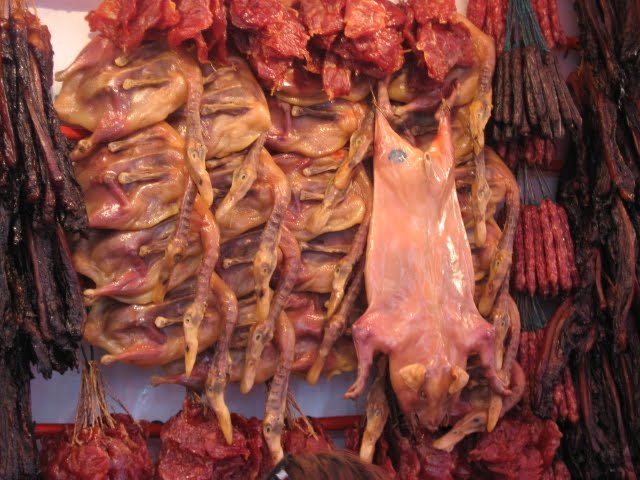
All those megamalls have extended food courts in them, usually on the lower floors, catering to the widest swath of appetites with the familiar sanitized décor one associates with megamalls regardless of country. Many of these places were labyrinthine with crowded, crooked pathways lined by food stalls with hanging poultry and dishes on display behind sneeze-guards. Lady T____ and I had one or two good meals and the same number of bad ones at these places. I recall the dim sum was enjoyable and the laksa surprisingly delicious, but the barbeque pork on two counts was dry and unimpressive, while some bowls of soup were too oily. The reader shouldn’t be surprised if the relish dishes, presented to them as complimentary show up later on the check, just above the wet napkins. The going rate for a saucer of pinto-like beans is $3 Singaporean and moist towelettes can be upwards of 50¢ to $1.50 Singaporean (37¢ to $1.10 USD). This practice seems widespread, primarily in Chinese establishments, and can be attributed to “local custom.” Bringing it up for debate to your waitress or cashier will only get you a blank stare. Singapore is not a tipping society, so expect service fees included on the check. Had I known of the hidden charges, not only would I have refrained from taking issue with the waitress, but I would have kept a more accurate granule count of the salt I shook from the shaker, down to the penny-weight.
In the gritty '70s my parents visited Singapore and patronized some food stalls set up at some vacant parking lots. My dad suggested that, if the food vendors were still in that practice, they should not be missed. But miss them we did. Perhaps those culinary bazaars have since morphed into the hawker centers that now dot the city. We did patronage those. One such place was Newton’s Circus, an irregularly

angled ring of a building with an open-air center full of round tables shaded by umbrellas and an outer perimeter eating area with long cafeteria tables radiating out in sectioned rows under a fiberglass awning. There seems to be more than four directions a person could approach this rotary food center, indicating its peculiar location. It mainly attracts workers and local residents, though I wouldn’t doubt a fair share of business is done with tourists. Newton Circus is a few blocks away from Orchard Road and the concentration of hotels that flank it. We walked a short ways to get there. The food offered forms a sort of Singaporean mix – stuff from all over Asia, with heavy representation from Malaysia and southern China - often prawns and other shell fish served up in soups or noodle dishes or splayed out on banana leaves. Every four or five stalls there would be a space specifically for cold beverages. Any fruit you can find on the island can be quickly juiced. We had sugarcane on one occasion and guava on another. Both drinks provoked curiosity but did not quench expectations. During the latter part of the trip, Lady T____ and I would drink primarily Japanese tea, water or Tiger beer. The food at Newton’ s Circus was delightful and well worth it.
For finer dining, I could not begin to recommend places to eat, as there are so many. Beneath every hotel is a restaurant and next to that is a cocktail lounge. The Mandarin Hotel has the finest buffets (
The Triple Three) that I have ever seen, offering dozens of cuisines from sashimi and dim sum to fried chicken and brisket - all done up in a fanciful way. Las Vegas can only dream of such a buffet. The price is not cheap and the prospective diner will no doubt confront the large buffet dilemma: whether it is possible to take full advantage of the selection in one sitting and eat your money’s worth or not. It is not possible, at The Triple Three, to sample every dish of the buffet with just a human-sized stomach, so the issue become one of prioritizing.

Along the Singapore River is a stretch of nice restaurants offering open air dining beneath a continuous tenting that is perhaps a hundred yards long or more. Each restaurant has indoor climate controlled seating across the narrow pedestrian street running parallel to the riverbank. Go one block further and you will find a concentration of clubs with call girls loitering up front. I, at first, assumed this was the red-light district in Singapore, but it wasn’t. That place was north of the river a couple miles away.
Go up river and there are the aforementioned megamalls on both sides of the river with lots of finer dining on all the levels, indoor and outdoor. If I recall, during the night we spent in that area, we ate some decent sushi at the oddly named A971 Cafe and later followed that up with some Hokkaido ice-cream, while listening to a traditional Japanese drum troupe go about a summer festival dance. Lady T____ thought the shirtless conductor of the troupe was ideal eye candy to go with the green-tea ice-cream, especially when he laid on his back and played his drum in an unorthodox position. I could not quantitatively disprove her assertion, so I let her quietly gawk at him while humbly enjoying my portion of the ice-cream cone.

Prior to arriving in Singapore, T____ had two aims, regarding food she wanted to try. The first was some laksa, a soupy affair with a rich broth fusing coconut milk and curry and served with rice noodles, tofu and shell fish. It can be spicy, though each time we tried it the spiceness was subdued. Oddly, Lady T____, who is not a fan of coconut or cilantro (served as a garnishment), enjoyed this dish. The mixture in the laksa found her happy spot and today she pines for it. The laksa we had in Chinatown went particularly well with our other dish: a very moist roast duck accompanied by a mysterious green dipping sauce that seemed to physically cool the body. That meal so refreshed us that we walked around for the rest of the day without a thought regarding the heat.
As with her first aim, the second aim was met in Chinatown. A couple of her friends recommended a particular bakkwa place in Chinatown, so when we emerged from the station, we combed through a dozen other bakkwa vendors until we reached the right one. Bakkwa is a Chinese style jerky made generally of pork or beef. It is aggressively cured and respectfully seasoned and tends to be a little softer and chewier than American stilly jerky. The place must have had a reputation because there was a line down the sidewalk. It moved quickly and in no time we ordered up a sackful with one style each of the beef and the pork. We ate from that sack for the remainder of our trip and the stuff never got old!
CHINATOWN

Chinatown! Most every self-respecting world-class city has one, whether it's just a tiny affair like Barrio Chino in Mexico City or a more prominent part of town as in San Francisco, New York or London. "Ah!" you might say, "but what of Tokyo?" True, Tokyo is an exception, but wherever you are in that great city, hop on a train and you are no more than a transfer or two away from Yokohama, which has one of the cleanest and finest Chinatowns in the world.
Singapore's Chinatown was established through the Jackson Plan of 1822, not too long after Sir Thomas Stamford Bingley Raffles established Singapore in 1819. The story goes that Raffles left Singapore in the charge of William Farquhar, who was the 1st Resident of Singapore, and returned to his post in Bencoolen, on the Southwest coast of Sumatra. When Raffles returned to the still fledgling port, Singapore had grown considerably under Farquhar’s laissez faire governance, but there was no organization. The settlement was like an untamed lawn and Raffles went about enacting a bunch of city planning initiatives. Of things he did, he established the committee that came up with the Jackson plan, which set up Chinatown, Little India, Kampong Glam (the Arab district) and all the other districts in the core of the city. Calcutta was Singapore’s governing parent and is often referred to as the Indian Government and maintained a threadbare footprint – providing Singapore with very scarce resources to manage over itself, a practice that continued up through 1867, when Singapore became a Crown Colony, and its governing parent shifted from Calcutta to London. During that time, the local districts essentially governed themselves, and the Chinese proved exceedingly able to organize their own affairs. Even after becoming a Crown Colony, according to C.M. Turnbull’s
A History of Modern Singapore (Singapore 1977), an official committee report in 1875 stated: “We believe that the vast majority of Chinamen who come to work these Settlements return to their own country not knowing clearly whether there is a government in them or not,” referring to the colonial offices.
The Chinese community has been an economic powerhouse throughout Singapore’s history and it has produced some impressive merchants and philanthropists. Even by the late 19th century, much of the western presence in Singapore was confined to the port, while inland was mostly occupied by Chinese and Malay plantation owners. In short, the Chinese were quick to seize the promises of Singapore island while the British were seemingly content to keep a free port open to all.
You might wonder why a city that is over 70% Chinese needs a Chinatown. With such hefty share of the demographics, is not Singapore essentially, in its entirety, a Chinatown? Whatever the answer, it is still surprising that just as in so many cities, the district is distinct from its surroundings. You will find narrow streets with quaint little shops selling clothes, trinkets, and Chinese medicines under awnings. This is the place to buy tea or Tiger Balm or any Chinese herbs. It is also the place to buy a lot of inexpensive but interesting souvenirs for friends and family.
The site that I most wanted to see in Chinatown was
Sri Mariamman Temple, the oldest Hindu temple in Singapore, established in Chinatown because of the area’s plentiful supply of water. The gopuram looked much larger through the online photos and brochures than it did in real life. I somehow expected a strikingly grand entrance - so ornate and peculiar in its design, but if I was in a cab hurdling down the street, I might not have noticed it at all. We approached it on foot and from behind so we were right upon it before we recognized the entrance.

I've never really determined how much I appreciate Hindu architecture, which often seems to be a construct out of small ornate details - figures, usually people and animals and gods molded together to form something larger. It certainly does not lack interest, nothing of that sort, but sometimes it appears that the people
are the bricks and pillars and something about that has always nagged at me, as if it was dehumanizing. The gopuram at Sri Mariamman was not so cluttered though, meaning that the human figures did not seem to serve as the structure’s load bearers and and I could admire it with a carefree mind. The humble stature of the entrance and the colors and texture of the materials made the building look less than permanent to my mind - certainly not so aged as the wooden temples and shrines in Japan or the ancient gardens in China, with their stone pagodas and pavilions. Those places look as though they intend to stick around awhile. The current manifestation of the Sri Mariamman, particularly the gopuram, was built in 1925 and seems deadset on decaying. It was refurbished in the 1960s and is currently in good repair, the paint is bright and crisp and cleans, but so is my house and it is just as old. Parts of the temple date back to the 1840s and other parts of the temple grounds have been changed and altered, torn down and rebuilt. Both Lady T____ and I kicked off our shoes and poked our head inside to check out what the place had to offer.

As the name of the temple indicates, it celebrates the goddess Mariamman of disease and rain. She must be listening to her followers in Singapore because the place has been largely spared the scourge of yellow fever, malaria and other diseases that have plagued other equatorial climes. There were a few attendants in the temple preparing for some event later that evening – erecting a portable stage and checking the sound system. I admired as much of the elaborate paintings as I could before one of the attendants ushered us away from an area unmarked as restricted, but apparently off limits to non-members. We confined our site-seeing to the area immediately around the entrance, which had dozens of murals along the walls and ceilings. It wasn't the Sistine Chapel, youth alone prevents it from being such, but it was easy on the on the eyes. With its direct angles and symmetry as well as its neatness in detail, I was reminded of 20th Century Native American water colors artists.

Leaving the temple, Lady T____ shopped around and found a few frocky blouses - the type that always catch her eye on the rack, but that she never buys or wears. It so happened that during the trip I suffered from a particularly stiff knee aggravated by the three airplanes and 26 hours of travel time it took to get her. When Lady T____ noticed me limping and wincing every time I bent that leg, she suggested, since we were in Chinatown, I should enlist the benefits of foot reflexology. A block later she found a place, behind one of the shops and upstairs on the third floor. It looked out of the way and I didn't notice any signs for it, but Lady T____ somehow did. We climbed up the stairs to a darkly lit room that stretched the length of the building. Aside from Lady T____ and I, there looked to be only one other customer in the place, though the darkness of the room and our still adjusting eyes, so recently in the broad daylight, made it hard to know for sure. The young fellow greeting us at the door led us back through the long narrow room passed pairs of recliners, each with a masseuse station, until we reached the most remote pair. We sat down and waited.
"You should ask the reflexologist about your constipation," Lady T____ suggested. When traveling, my valve will often close tight and though it wasn't a pressing issue during the current trip, it had been one in the past, and Lady T____ knew this.
"I'd rather not," I said.

Lady T____, though, is persistent and when the masseuse came out to us, Lady T____ first asked her about the prospects of foot reflexology helping my knee. The lady gave a blank stare. We had found the one person in Singapore that did not speak English. She fetched the young man at the greeting station, who in turn brought the owner of the parlour. When the three of them were around us, Lady T____ again asked her question:
"He has a stiff knee," she said, indicating me, "and we would like to know if there is a part of the foot that will help cure that."
The three thought for a minute and discussed the matter to themselves in Cantonese before the young greeter explained to us in soft English: "Well, for his knee we should actually massage the knee
directly." He figuratively rubbed his own knee to demonstrate what he meant.
Fair enough. I confess that I've never fully understood the remote connections between the foot and the rest of the body. Lady T____ moved on to the matter of my movements.
"Okay," she said with a thoughtful pause between syllables. "He also has had some constipation and we would like to know if there is any part of the foot that can help that." When there seemed to be some confusion regarding the exact meaning of constipation, she further explained that I was "having trouble pooping."
They understood that, and even understood the term, “constipation,” now that they converted it to their own pronunciation. They discussed the matter among themselves and looked at me reclined in the chair, staring specifically around my gut and intestines, now and then glancing up to my face, as if something might reveal itself that would help them fix the issue.
"For that," the greeter explained, "we would not really massage
the foot, but would massage directly here," said the young man indicating his belly. But we were there for a foot massage and not a full body massage. My masseuse, realizing my problems, went about the routine of the massage, finding pressure points on my feet, but then proceeded to massage up my leg to my knees as a freebie.

I've never enjoyed massages, as I am generally too tense and ticklish to delight in them. I was uncomfortable when she moved to my knee as I felt vulnerable, yet the whole thing was not so bad, and the only wincing I did was less a matter of reacting to pain as it was anticipating it.
We paid our money and left. For the duration of the day I noticed that my knee gave me very little trouble and my legs were, on the whole, completely relaxed and fuzzy with comfort. Even hours of shopping in Chinatown and along Orchard Road that evening did not provoke aching pains on my heels or calves. I have often mocked the therapeutic attributes of foot reflexology in the past, but I can no longer deny its benefits to a pair of tired feet.
As for my constipation: I am not sure if it was a result of the massage or something to do with the dinner served on a banana leaf that night, but I was overly cured - to the point that, two days later, when I was getting a second foot massage, I almost inquired if the reflexologist, an older man who seemed more clinical than the first gal, could engage his podiatric sorcery to remedy a case of the backdoor trots.
CIVIC AREA

St. Andrew's Road ran parallel to the shore line at one point, before generations of land reclamation filled in parts of the coastline, adding entire new tracts of land. Now the sea is obstructed by twin orbs of
the Esplanade, like two halves of the durian fruit lying insides down on the green and sandy ground, and the biblical looking towers of Marina Sands Bay™, a modern man-made Ararat with an ark atop. Is this vessel waiting for the Flood? Is it seaworthy? Or will its cement hull crumble and sink to the ocean floor? St. Andrew's runs south and stops a block before intersecting with the mouth of the Singapore River. It is a short road, less than half a mile in distance. The

west side of the street, at the northern end, is adjacent to its namesake, St. Andrew's Cathedral (pictured above), a neo-gothic structure of sharp and crisp angles in the middle of some well cultivated grounds. Coleman Street passes the entrance and offers the best view, though it is partially obscured by angsana trees. As we passed, workers were erecting a tent and building a stage. Walk further south and on the west side of the road is the City Hall, a long stately neo-classical building built in the 20s. Next to that is another neo-classical building, complete with a dome - the old Supreme Court building. I will say it again: British architecture in its former colonies is a wonderful blend and contrast to the surroundings, whether it’s the Virgin Islands or Singapore. To the east side of the street was a field, mowed and readied for soccer and other pastimes.

Lady T____ folded her Japanese map and tucked it in her hind quarters of her jean shorts and walked on in front me.
"Does this look funny?" she asked.
"Not at all," I said.
"Really?"
Lady T____'s habit is doubting me.
We continued to the end of the street, south of the old court building, and saw the Victoria Theatre and Concert Hall, a beautiful white building. In front of the hall is a bronze statue of Sir Stamford Raffles, one of two by
Thomas Woolner.

Sir Stamford Raffles, as previously mentioned, was the man who birthed Singapore. He was a product of the Enlightenment and embodied those values. He had particularly long vision and heroic persistence, achieving most of his successes in a stiff headwind. Today, he is firmly celebrated as the founder of Singapore - his current legacy manifested in this statue, though, is not just a reflection of his founding of the city, but of the city itself. At the time of independence from the British in 1965 and during a period of strong resistance to its colonial past, there were, according to C.M. Turnbull, people desiring to topple the Raffles memorial statue into the Singapore River and do much the same to his stature in the history books. How widespread this sentiment was I don’t know, but the yoke of colonial rule invariably feels heavy and resentment roots itself deep, regardless of whether the colonial power was harsh and cruel like the Dutch and the Spanish or relatively congenial like the British. It is a testament to the wisdom of the Singaporean people that Raffles remains celebrated, though with added scrutiny. His legacy, I have ever confidence, can take it. That kind of tolerance is at the very heart of the Singaporean character.
Prior to founding Singapore, Raffles, having gained the favor of the Governor-General of India, was appointed Lieutenant-Governor of Java when the British assumed control of that island from the Dutch in the wake of the Napoleonic Wars. He quickly went about reforming - abolishing slavery, establishing a land tenure system and injecting self government among the people. He often did these things without the support or enthusiasm of the government in Calcutta who was more involved with the balance sheet of their possessions. When Java was handed back to Dutch, Raffles returned to London and earned a knighthood for writing
A History of Java. His reputation as an administrator was tainted by his zealous reforms which disrupted the local economy and

cost the company money, though that did not prevent him from receiving a new appointment as Governor-General of Bencoolen in 1817. All the while he was pre-occupied with the need for a free-trade port in the region to check Dutch hegemony and secure freedom of trade for British commerce between Calcutta and China. Despite the political climate in London and Calcutta, which was in no mood to acquire more overseas obligations, Raffles discovered the island of Singapore, recognized it as the perfect location for his dream port and managed to wrangle an agreement out of the local sultan allowing for a port on the then scarcely populated piece of land. No doubt Calcutta rolled its eyes and for the next few years was ready to cut the line as soon as British presence in the otherwise Dutch controlled region soured diplomacy with their European neighbors. Somehow, the little free-trade port-that-could took root – mainly with Chinese entrepreneurship and showed enough commercial viability for the British East India Company not only to keep it, but to buy control of the rest of the island. Raffle, whose primary job was still Governor-General of Bencoolen (founding Singapore was his hobby) was away from Singapore during the first few formative years and it sprouted like a weed. He returned only once, a few years after the founding, before returning to London. He died of apoplexy in 1826, in debt. Raffles accomplishments and life would be too big for a single volume biography, no matter how thick, let alone a paragraph in a report on Singapore like this one. The point being that Raffles - his character and life - appealed to me so that I felt compelled to see his figure heroically displayed.
Lady T____ refused to appreciate why I would want to see the Sir Stamford Raffles bronze statue in front the Victoria Theater and Concert Hall near the Fulton Street Bridge. Twice, I recounted the reasons, touching on key exploits from his biography, but she was either not listening or did not care to wrap her head around my fascination for the man. Lady T____ is not long on patience but can be a sport when the occasion calls for one. She had a harder time wondering why I wanted to see the
other statue of Raffles, the original marble one in the same pose as the bronze reproduction, but a block and a half away at his historic landing site. Yet, after she took my photo with the statue at the concert hall and I was putting the camera in its pouch, she insisted that I take a picture of
her next to the great man.
RAFFLES HOTEL

Raffles's name is everywhere in Singapore. Raffles Hotel is historic in its own right. The hotel started out small, but grew over the years to become a vast Victorian building with large courtyards and tropical grounds. It has gone back and forth between a popular luxury hotel and a dilapidated building. Its register has hundreds of famous names like Joseph Conrad, W.S. Maugham, Charlie Chaplin, Jean Harlow, Ava Gardner, Queen Elizabeth, Beyonce…..the list goes on and on. It’s the setting of several books and films. In its bartending laboratories the Singapore Sling was invented. Fable has it that Raffles Hotel was where the last tiger on the island was killed in 1902. The

place is now bigger than it ever was, with a wing of shops and more restaurants and bars (not to mention a nice hotel museum). Even for the traveler not staying at Raffles Hotel, it is free and well worth a visit. Evening obligations cut my visit short and I had to hurry back to the hotel before dinner hour. If fate provides that I return to Singapore with an adequate budget, I should like to stay at Raffles a night or two. Joe citizen, back in the days, though, didn’t have it that good. So long as there were filthy tenements breeding dysentery, miserable rickshaw runners with opium habits, and secret societies praying on poor Chinese laborers in the flimsy guise of protection, Singapore’s exotic luster would be forever besmeared with a dark side. Singapore’s grace, part of the original vision of Raffles, I think, is its inherent devotion to free trade capitalism. Even the socialist elements of Singaporean politics – the centralized industrialization and public housing – has not overtaken that devotion to capitalism – and as a result, the overall quality of life of its people has historically trended up. Now, it’s not just the affluent traveler and the wealthy merchant who can enjoy the pleasure ground aspect, but most everyone. They even have an entire island at Singapore's southern tip designated as a playground.
SENTOSA ISLAND

Sentosa aims to be Singapore’s
Pleasure Island and the bridge to that dream has already been built, literally. The city subway (MRT) doesn’t go directly there, only as far as Harbour Front Station. From there you can take the monorail, the bus or a cab. You can also get there by ferry from the Marina South Pier, or by cable car from Mt. Faber. We chose the bus that departed from the far side of the station. The view from the bus window was narrow and barely anything about the island could be perceived, except that it looked we were headed to a wall of verdure, like a hillside. The bridge passes Pulau Brani, an island used as a major cargo terminal, which looks as though it were made entirely of stacked containers and towering crane arms. It was hard to tell

that the bus was on a bridge and not an embankment. After going through the toll gate, it looked as if we would drive around the hill up, but instead the bus turned into the hillside and we found ourselves deposited in a great cavernous parking garage and bus terminal where we followed the crowd to a long escalator bringing us up to a open but covered visiting center in a place called Resorts World™ Sentosa. Sentosa is completely man-made and artificial. The buildings, hotels mostly, are styled after places in old Europe, with a gargantuan fake feel that reminds one of a theme park or Las Vegas. Of the latter, there is a Universal Studios theme park almost fully build, operational and due to open weeks after our visit. We could see some of it over the perimeter fence. There was a Merlion statue, a similar rendition of the city landmarks in
Merlion Park, except larger and with a spiral staircase inside.
Our day on Sentosa was the hottest of the trip and the hilly climbs to get from one attraction to another caused considerable sweat and discomfort for Lady T____ and me. We both had shortened tempers and were ready to take issue with whatever the other said. We found common ground in the belief that Sentosa, on a hot day, must break up couples by the dozen. We took the monorail whenever we had any considerable distance to travel. Had the island been flatter with a more agreeable climate, one could easily walk the

length it. But it was not so. We went to
Images of Singapore, a fun family-style history museum introducing tourists to the peculiar origins of Singapore through an invented “Four Winds” motif representing the trade winds, and the varying cultures (Chinese, Malay, Indian, European) those winds brought to Singapore’s shores. If I recall the way the museum covered it, the four winds also represented four key wishes the immigrants shared: a wish of Family, Community, Peace and Harmony. This element of the museum was a little silly, but I’m a sucker for vignettes and historic dioramas and the Images of Singapore delivered on that front. For tourists interested in history, however, I would recommend a more serious museum.
The National Museum of Singapore has extensive collections covering all the periods of Singapore’s history, along with one of the most comprehensive and well laid out audio programs I have ever seen).
The attractions at Sentosa are pay as you ride, so it can add up. Package deals are available, but at what cost savings I could not tell. Of the several attractions that we decided to do, Lady T____ wanted to challenge her acrophobia on Sentosa's
Mega-Zip, the longest and highest zip line in Asia. So we hiked up a steep narrow road, leaving the people and attractions below, their sounds soon replaced by insects and birds as we were swallowed up in the jungle verdure as we approached the summit. I dripped sweat in the heat and humidity. Lady T____ maintained herself a little better than me. One turn away from the Mega Zip staging area, at the top of the steep hill, a long golf cart carrying Mega Zip customers from the beach below passed us, the kids in the back heckling us as we plodded behind, slower and slower, up the incline. We go there, bought our tickets and waited to be fitted with the harness. The air was so still that I continued to perspire, soaking my shirt and pants. A young Malaysian worker, so tan and athletic that I could not tell if it was a man or a woman, helped me into the harness and made the proper adjustments. From there, we were led to a tower, climbing about four flights of steps to the cables. Looking down from the summit, I was struck by the view of the ocean and so many hundreds of cargo ships and tankers as far as the eye could see, reminding me that while we were enveloped in the jungle terrain of the hillside, Sentosa Island was enveloped in one of the busiest ports in the world. These vessels brought the trade and profits that allowed for the development of Singapore's new playground.

The zip line was high up, but otherwise not especially thrilling, moving as slow as it did. After the British man working the launch platform latched me to the cable and pushed me on my way, my body turned around so that I slid down the line backwards, unable to see where I was headed, only where I had been. Efforts to correct my orientation with the line were unsuccessful and I completed my zip line experience backwards, slowing to a halt about twenty yards from the end of the cable, just as I reached the netting. I had to awkwardly crawl to the receiving platform, where I was unhooked and released from the care of the Mega Zip people.
After the zip line and so many other outdoor activities, like the luge and sky-ride, it was necessary to cool off and replenish - so we went to a parlor outside of
Underwater World - an aquatic center that offered, among many other things, an underwater observation tube, a swim with the dolphins for $150 Singaporean, or a swim with the sharks for $120 Singaporean. While I did have money in my pocket, neither Lady T____ nor I were seduced into diving in with some wet carnivorous friends.

Next to Underwater World, at the westernmost tip of Sentosa is
Ft. Siloso, the most historically significant site on the island, one of about a dozen coastal gun batteries the British trained on the Straits - beginning in the 1870s. The two six inch guns at Ft. Siloso, along with the neighboring gun placements, were supposed to make Singapore as secure as a fortress, and for over half a century, it may have. When the Japanese seized Singapore, though, they did so by coming from the Malay peninsula, which meant that the guns were pointed in the wrong direction. After a spirited defense, the British forces fell and the Japanese took over, tried to co-opt the Indian soldiers to split from their "British oppressors" and rounded up and slaughtered much of the Chinese population. The guns had become a British version of the Maginot Line. The fort was used as a prison camp for the rest of the war. Today, mannequins man the guns in much the same, appearance-wise, as the British soldiers prior to the Japanese invasion.
Near Fort Siloso and Underwater World is a parlor offering
fish reflexology - the ancient art of letting small flesh eating fish exfoliate your feet. It was something that I really wanted Lady T____ to try, as it was just the sort of gimmicky thing she enjoys. At the last minute she convinced me to have my own feet treated, along with hers. We were led first to a rinsing station, where we cleansed our hot sweaty feet,

careful not to use any soap or lotion, which would harm the fish. Upon providing us with sandals, an attendant led us to two pools, both full of fish, explaining that the first pool contained small, less aggressive fish, while the second pool was populated with larger fish. Before we arrived to the pool, the joke was that the fish might die trying to eat the dead skin of
my feet while those same fish would die of hunger around Lady T____'s feet, since she so carefully tends to them herself. The attendant startled me when asking if I had any bug bites or open sores, explaining that the fish would concentrate on those areas because of the blood and raw tissue. It occurred to me that this was not so much different, in spirit, than a swim with the sharks, though these little fishes, even in the bigger, more aggressive pool, would carry off smaller mouthfuls. There were no other customers at the two pools, and when I looked over at them, both were bubbling and churning with hungry fish. I started having second thoughts.
Lady T____ answered the attendant for me saying that I would use the pool with the larger more aggressive fishes. I rolled up my pants and started to lower my feet to the surface. The bubbling and churning increased exponentially as the little inch long flesh eating fiends became wild with expectation. Lady T____ was also wide eyed with expectation - partly to see the fish going after my feet, but mostly because she would be next.
Reader, you know that sensation when you are about to engage in something that will shock the body's senses? That was the feeling I had as I lowered my big toe to the surface of the pool. The first fishes to attack my feet tickled me so, like little finger nails lightly scraping against toes, arches and heels, that it took me several minutes to submerge my right foot, then my second. The cloud of little one inch bodies totally obscured the bottom of the pool about a two foot radius around my legs. Lady T____ then decided, through my urging, to put her feet in the same pool. The look on her face and her clenched fists were worth the trip to Singapore alone, as she worked up the nerve to overcome her anxiety and fully submerge her own feet to the mercy of the fishes.

The feeling of hundreds of little mouths sucking on feet becomes more bearable over the course of a few minutes, then downright delightful after a few minutes more. Our time in the pool was slated at 15 minutes, but after about 10 minutes, a young Indian fellow came to share the pool. When he submerged his feet, about half the fish that were concentrating on my dead skin, went over to him and all but one solitary fish tending to Lady T____ left her to seek their fleshy fortune with the new entry to the pool. None returned to Lady T____ and after a few minutes she looked up at me with pathetic eyes and said sadly, "I have only got one fish." The man apologized for hogging the flesh eaters, but what could anyone do? The fish make their own decisions.
We removed ourselves from the pool, rinsed and soaped our feet and then enjoyed the second foot massage of the trip (and the second such massage of my entire life). My second reflexologist was an old man that seemed to know his stuff and did more in the way of manipulating the pressure points on my feet. Again, after leaving the place, my feet were comfortably numb or otherwise totally relaxed for the remainder of the evening.
CONCLUSION
Of the things that I discovered in Singapore, I learned that meals on banana leaves, when combined with foot reflexology, can be a digestive godsend or an intestinal nightmare and sometimes both in a thirty minute period. Singapore answered the call and did provide both Lady T____ and I with a much needed rest. When it came time to go, though, I tried unsuccessfully to extend my trip only to learn that the One World Alliance that American Airlines promotes is actually nothing of the sort and it was going to cost an arm and a leg to stay an extra 72 hours. In hindsight, the trip was adequate in length. I would love to return at some future date to see the things I did not get a chance to see this time around: the
Asian Civilization Museum, the
Esplanade, the
Marina Bay Sands complex, and, of course, Gong Li.
A note on the pictures: most of the photos above are mine, with a few found online, such as the interior of Ion mall, the shot of Sri Mariamman Temple in 1843, the Ion food court, and the Mao shirts - in fact, most of the shopping and fashion photos were online, as was the Ft. Siloso mannequins manning the gun. The daytime shot of Singapore's skyline was found online, too, along with some other pictures, though I don't have a link for those.
 "#99 – Adorable things




.jpg)


